
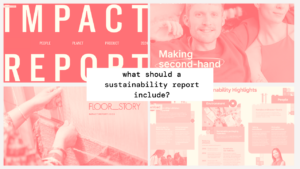
Pick up a company report on absolutely any subject, and you’ll know how it’s going to play out within three sentences. That opening page will tell you whether you need to steel yourself to get to the end or actively engage with the contents, without being tempted to check your emails even once.
So how do you build a compelling sustainability report?
We’ve looked at a fair few sustainability reports in our time, so have pulled together some examples of what works.
LEGO has grounded their sustainability strategy in the core of their business: LEGO is for kids, kids are the future, we’d better make sure there’s a future there for them. It’s a clear message, and one that engenders confidence that the company is committed to their sustainability transformation.
Vinted have here included a really simple way of accessing previous reports, right within the intro. It shows they’re happy to stand by their progress, and they’re willing to make it easy for interested parties to really go deep on their sustainability commitments.
A significant proportion of Brompton Bikes’ target demographic know their way around a Tone of Voice document and other marketing paraphernalia. So it’s probably fitting that they’ve included a deep dive into their purpose, looked at through a climate lens. We don’t begrudge them that, because it’s a really nice colour and a good font – and beyond that, it’s actually quite interesting.
Peak marketing, really.
This is from a solar installation company, Svea. The subject matter may be on the drier side, but the language makes it accessible. They didn’t have to make it so, their report will probably primarily be read by solar-literate contemporaries. But we’ll bet those solar literate contemporaries appreciate the language choice, giving them a welcome break from the vast majority of renewables literature.
Floor Story makes rugs, and they’ve used their product to really ground the impacts of their business in an illustrative journey. Material impacts is a phrase increasingly seen in the world of sustainability reports, but this makes it simple to understand in case you’re not deep in that world. It’s a magic carpet ride through material impacts, if you will.
They’ve also included the founder’s six favourite rugs. Was there a discussion in meeting room three (Shag Pile) where the marketing department pointed out that this possibly didn’t belong in a sustainability report? Perhaps, but we’re into it. As long as no one is printing this report out on virgin paper, adding a page of two of light relief injects a bit of personality into the whole proceedings. And if you’re not a company that trades in personality, there are plenty of other ways to add colour, such as the previous supplier interview format or a well designed infographic.
Rapha is a bike brand that gets right to it. While other brands might integrate targets and achievements throughout the report, Rapha is putting their cards on the table. This is particularly admirable, because frankly, they’ve still got some work to do. There are a lot of companies reluctant to publicly commit to anything sustainability-wise, so the inclusion of this chart is a brave move that should inspire other companies to put their targets where their mouth is.
Or ready to talk about how we can help your business use your sustainability story to win more work?